My Soundscape (4/14)

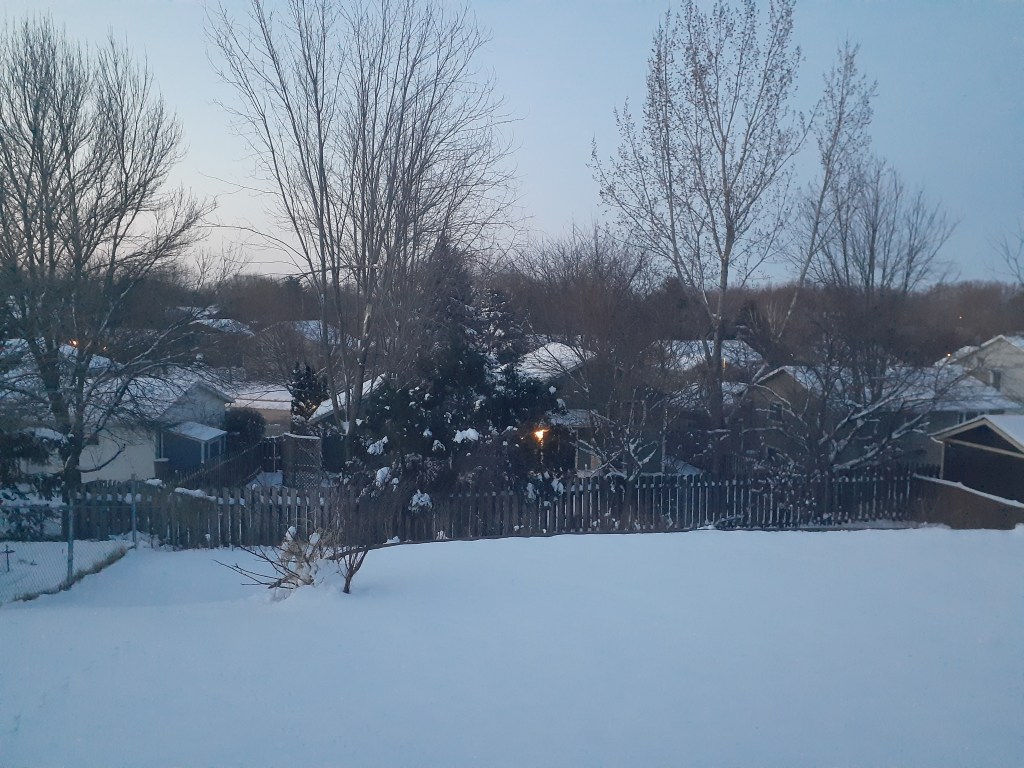
Hello again, and happy Tuesday. This morning, I stood outside of my house for several minutes at dawn to record the sounds of the natural world waking up with remarkably little noise pollution to interrupt. I have attached my sound file, along with an image of my very Minnesota-looking backyard to garner your sympathy.

Soundscape

Please note: If the embedded playback doesn’t work on your computer, you can follow this URL (https://drive.google.com/file/d/17nU4goiVZZFdRS7l6Z4HJs0JpkMXGdtn/view?usp=sharing) to listen to my soundscape.

In other news, I have recently begun working on my second semester final project, my plan for which was discussed in my last video update. Specifically, I have begun to record water sounds on my phone, and I’m starting to troubleshoot how to actually map the water sounds to the sound of the human voice. It may appear to be a simple project, but getting those nuances just right and in a convincing way is going to take a lot of planning and organization. I’m definitely glad P.J. made us make a score in advance. In fact, the next logical step for me may be to create another more detailed score mapping the inflections and rhythmic elements throughout the prayer.

I hope you are all doing well (and maybe enjoying better weather than I am).

Listening Response (4/9)

Good morning, and happy Thursday to you all! The past couple weeks have been challenging for all of us, and I have to say I’ve learned a lot about how much I actually miss the ambient noises of everyday urban life from being locked in my home with little more than the sounds of air conditioning, the sorrowful news emanating from my family’s television set, and the sound of my computer’s keypad as a type my way through all of my classes. The difference in noise level from traffic sounds coming from the highway located a mile from my house is also noticeable. And it is for that reason, that the sounds and the overall experience of Ride were a nostalgic experience, reminding me of what life was like in the not so distant past.

Overall, the piece reminds me quite a lot of El Tren Fantasma, a piece reviewed in a previous blog post. This is especially true in the sense that both works comprise of industrial sounds whooshing past the listener in what feels like a ride through various settings. In the case of El Tren Fantasma, the primary contrast throughout the piece was between the industrial sounds of urban areas and the natural sounds of rural areas, both of which would be encountered in the course of a train ride. Yet, in Ride, the primary mode of contrast was between the industrial sounds of urban life and the more intimate sounds of a more contrived idiom of musical expression—specifically with the sounds of recognizable musical instruments.

Some moments that best illuminated that contrast in my listening experience were the pairing of the sound of a string section and horns around the 5:30 mark. The strings emerge from a blend of airy noises in a very seamless way. This string sound becomes a motif reappearing around 15:30. I also really enjoyed the synthesizer-like sounds at 7:30; they reminded me of the sounds in the underwater parts of Super Mario 64, one of my favorite video games. Perhaps the intended effect was to transport audiences back to an earlier time. If this is true, then ride isn’t only a journey through space, but also through time. Possibly the most evocative part of the my listening experience was the result of a technological glitch. At 14:39 in the middle of a crescendo, the sound file suddenly paused. The effect was jarring—as though the ride had suddenly come to an end. It felt, in a sense, like the experience of a sudden car crash, or in a more figurative sense, a life suddenly cut short. After perhaps a minute, I realized that this was not supposed to be, and, finding the sound file paused, finished listening to the piece.

Going forward, I’m excited to begin a new project which sill occupy the rest of this semester. It was quite difficult to think of a piece that would be meaningful and which I could produce with the sounds available from my home and which will be satisfactorily distinct from my planetarium piece. My idea is an arrangement of the prayer “Hail Mary.” The prayer has a distinct rhythmic character that is recognizable even when divorced from the words. As such, my plan is to repeat the prayer several times with different rhythmic sounds and to conclude with a plainly spoken version of the prayer with my voice. The prayer would be especially meaningful in the present times, amid the darkest days (yet) of the coronavirus pandemic. A link to a video description of this project is posted below:

https://drive.google.com/file/d/16EMUSZxlXkkFd5c8iQF19IkTDROUDa2I/view?usp=sharing

Listening Response (4/2)

In what has turned out to be a quite hectic couple of weeks since my last post, I’ve made a lot of progress on various things. Because Luther has graciously loaned a laptop to me over break, I can now use Reaper at my home, which will make future projects much easier. Unfortunately, after moving back home, I realized I had not properly saved my sound files on my portable drive and as a result could not continue the composition project had begun in the past several weeks. Due to the nature of my original plans, I realized it would be impossible to get the sounds I would need from my home, in which I am presently on lockdown, due to the Covid-19 pandemic. I instead chose to start a completely new project, using what sounds were available to me in my home and recording them on my phone.

As you may have seen, my new planetarium composition traces the experience of a person being awoken multiple times by his alarm clock, and quickly drifting back into sleep time and time again, with each dream having its own sonic environment. Considering the challenges I faced, I’m very pleased with how my piece turned out; it even feels like a clear story exists—something I’m especially proud of. I’m really curious to hear about others’ experiences listening to my piece.

Of course, the highlight of my electronic composition endeavors in the past several days has to be hearing everyone’s planetarium compositions. I was truly impressed by the wide variety, and I feel all the more disappointed that we couldn’t experience this concert together with quality speakers and in a space where we could watch the projections of stars dance along with our music. Although I really enjoyed and admire all of the pieces, I have chosen to focus on Nolan Mancl’s for my review this week.

The piece utilizes verbal language and arranges it with musical ideas to create a density of meaning which neither music nor words alone could communicate. The people is a collage of the answers people gave him on being asked about the meaning of life and the nature of happiness. Remarkably, some participants gave answers that directly depended on the other question. For example, the meaning of life is to find happiness, and happiness of achieved through finding meaning. The bridge between ideas was so smooth, in fact, that I couldn’t tell the first and second movements apart on my first listening. Nolan’s piece also demonstrates a beautiful overarching aesthetic idea—namely, that the diversity of experiences and beliefs people have can create a beautiful whole. Our differences actually create music, in the most literal sense of the word.

It is for this reason that I can’t help but compare Nolan’s “Alive…Awake” to the choral finale of Beethoven’s Symphony No. 9, a piece which famously celebrates the rich diversity of our world through a set of variations on the “Ode to Joy” theme through different settings—a Turkish military march, a double fugue, etc. In some sense, Beethoven’s d-minor symphony is also a work of philosophy with a distinct argument, and a celebration of the journey towards meaning, as is Nolan’s work. Both works create this beautiful and musical journey with the help of many voices working together.

Post #9: An Update

This week I started work on the Mermaid project. In class, we divvied up some of the sound cues which will be used as backdrops for different settings. I chose to focus on royal music sounds. I proceeded to record myself buzzing my lips, and used Reaper to organize the sound files into a well-known piece (making frequent use of the EQ). I won’t share the name of the piece here as I would like it to be a surprise when I share my progress with the studio.

Regarding my midterm composition, I have made steady progress. I followed Dr. Joyce’s advice and rerecorded my sounds, limiting their total number to five or six. I’ve also began to put them into Reaper and organize them to narrate the story I have set out to. There are some technical things I’m still trying to figure out, especially how to make panning work, but overall, I feel the project is shaping up. And I feel confident I’ll have something cool, or at least presentable, to share with the studio next week.

Other developments this week include a short composition I’ve started writing (not electronic music) which I hope to be able to share in the student composition recital which Dr. Joyce has announced for sometime in May. Also, I must inform my readers that I will be taking a brief hiatus from my regular blogging schedule, and I will not be posting another blog this Thursday as I normally do. I need some time for catching up on things, but I plan to resume my regular blogging schedule next Tuesday.

Post 8: Listening Response

This week, I had the pleasure of reading Polly Teale’s Mermaid, a dramatic production soon to be staged by Luther College, a project in which the composition studio is excited to take part. I also listened to another extended work of electronic music, Michel Chion’s Requiem, a piece for which I am excited to share my experience.

Polly Teale’s Mermaid involves some parallel narratives. One is a modern American family stricken with financial uncertainty, and the other is a fantastical world of mermaids conjured by Blue, the daughter of said American family. Differentiated which world the narrative follows should be an important part of our considerations in the sound environments we create. In terms of specific sounds, the play practically calls for certain sounds to follow the creative imaginings of Blue–the sounds of fisherman, of violence and war, of time ticking on. One moment early in the show also calls for a live portrayal of the FaceTime sequence, which of course will require the appropriate sound effects, and perhaps prolonged in some way to accommodate a larger span of time. In general, I’m excited to begin working on this project; I find the play harboring a lot of potential for the making of rich sound worlds.

Equally important, I listened to Chion’s Requiem in the electronic studio, and unlike in previous assignments with the lights turned on as per Prof. Joyce’s recommendation. In stark contrast with tradition, the Requiem opens with an ear-blistering brightness, not the humbling darkness normally associated with a requiem mass. It is the sharp weight of a laser, not the distant levity of light that Chion imagines in the “lux aeternam.” The work proceeds to include large sequences of spoken words, from all walks of life–male and female, young and old. It is as though this requiem is for all of us. Rather that the regulated fire of hell–the assurance of justice, we hear in the “Dies Irae” the screams of confusion from deeper within the soul.

Of the ten movements, I was most intrigued by the last, entitled “Libera Me.” Appropriately, Free me from this aberration of sound, was indeed my first thought. I felt in one moment like I was in a hospital bed in my terminal minutes–accompanied by the inorganic sounds of equipment, and a dry voice in my head begging to be let go. In the next, I was slurping the last couple spoonfuls of a lackluster stew. It had a warmth and a gooiness that relieved me from the prior moment, but left me in perhaps greater hunger as the Chion’s Requiem can to a close.
Entranced by this music, I let the CD keep playing after the Requiem was finished, and what I heard continued to shock and fascinate me. The indigestion, a running motif in Variations, and the moaning sounds which permeate throughout Nuit Noire, give the impression of a hunger which lingers from the Requiem. Whereas I’ve always thought of great music as filling a cavity in my being, these artistic choices bring me closer to the experience of loss. It’s not beautiful, or wondrous, or nuanced in the same way as the Mozart Requiem is, but it conveys a message equally, if not more, intimate and profound–a closeness which is in fact as uncomfortable as hearing the indigestion or groans emanating from one’s own inner hunger.

Post #7: An Update

This week, I’ve had some exciting experiences relating to this course. On Sunday, I attended a performance of Dr. Joyce’s The Showing of Love. The work was composed for electronics and live performers together. The Friday before, I got to hear the professor talk about the inspiration and unique structural elements of his work. I was impressed how naturally structural intuition–like using an electronic interlude between each sung movement–translated into a structurally cohesive, and even elevating, musical journey. Equally, I was impressed by the level of research that went into this project and the degree of cross-curricular involvement as Dr. Joyce consulted professors of religion and literature to better understand a certain anchoress’ subjective experience of her soundworld.

I also had the opportunity to experience one of my peers’ soundwalks. While many of the locations were the same ones I’ve been to a lot (and also included in my own soundwalk), it was interesting to me the degree of freedom this soundwalk gave to the listener. Sometimes, it directs me to walk to the other side of campus without specific requirements as to which path to follow. I appreciated this, because it forced me to ask what paths I tend to follow and why. I decided to follow pathways that I don’t often take. Additionally, offering more agency to teh listener, this soundwalk recognize that our sonic experience of the world cannot be entirely divorced from our internal dialogue–questions of where we are headed and how to get where we want to go.

Lastly, I’ve made some progress with regards to my midterm composition, though admitedly, this has been stunted with some technological difficulties. Namely, I’ve recorded all, or almost all of the sounds I intend to use in my composition, and I’ve established a more conctrete plan for how my piece will progress, including stecific timestamps throughout the score and plans for how to create the desired effects from my raw recorded sounds. I also had an idea that I believe will challenge me and, through limitation of scope, help me to channel my creativity. That is, all the sounds I recorded were made with my body–clapping, snapping, stomping, buzzing, “shhhh”-ing, etc. The effect with be like the presence of a live storyteller, guiding the listener through the scene. But, I’ve mentioned some technical difficuties, specifically transferring the files from teh recorder to the computer. I wasn’t able to locate the sheet with the directions on how to do this, so I haven’t been able to begin arranging my work in Reaper yet. It is also for this reason that I haven’t deleted my files from the recorder. I should get this figured out in the next couple of days, though.

Post #6: Listening Response

This week, I had the opportunity to read Franscisco Lopez’s article “Blind Listening” and to listen to Francis Dhomont’s Foret Profonde. These two works were an interesting juxtaposition–one an argument for the untampered recording of natural soundworlds, and the other a composite of unnatural sounds greatly transformed from the source material. As such, the two offer polar opposite, but equally valid perspectives in our question about the effect of recontextualizing sounds in electronic music.


The reading by Lopez emphasizes a counterpoint to the perspectives previously reviewed on this blog. In his article, Lopez idealizes untampered recordings–truly honest representations of sound worlds. He suggests that artists seeking to depict the natural world through sound should set their microphones in arbitrary positions and not edit the recordings, even to adjust the balance to create a stronger spatial sense with some sounds in the foreground and others in the background. Yet, Lopez later concedes that it is because our experience of the soundworld is so wrapped up with our other senses that a truly objective representation of the experience of sound is impossible. He points specifically to our ideas about what wind or rain sound like–ideas which are in fact more connected with learned associations between the sounds of plants and trees under such conditions than the physical sensation of the weather patterns themselves.

Especially captivating in my listening of Dhomont’s work was Track #7. The track included a rare, extended example of an English narrative amid a recording that uses predominantly the French language. The narrative, while not particularly evocative on its own, carried a beautiful aesthetic in the context of the piece as a whole. The bright, clashing sounds which permeate in much of the piece momentarily gave way for this moment as a female voice emerged. Simultaneous feelings of darkness, warmth, and simplicity, ideas which mark a romantic idea of Medieval life, surfaced like a lone island in a sea of electronic sounds.

This short moment of continuity–a story which, while superficial and brief, had a sense of direction–was unlike the vast majority of the piece. In fact, after much consideration, I still struggle to sense a larger story in the piece overall, a feature which perhaps gives this piece the same unromantic qualities which Lopez idealizes in well-crafted sound world (which is to say, an uncrafted soundworld). The sounds themselves have little meaning in the larger context (even more so for non-French speaking listeners like myself), but exist only for themselves as does all life in the natural world. This brings us to an interesting question: what draws us to stories–in music, or in literature, drama, etc.? Do they in fact remind us of who we are, or offer an escape into a reality which far removed from our own–a reality in which our lives individually and in the aggregate resemble a story, or at least harbor meaning?

Post #5: An Update

I’m glad this week to begin working on a larger project which will be performed in the planetarium as part of a electronic music show presented by my class. This week, I have continued gathering sounds, especially water sounds, in which I have noticed my sound bank is lacking. I have also begun to sketch (literally) a score for my midterm project. This score is a pictoral representation/diagram that will help me navigate the larger structure of my piece as I compose it. For mine, I chose to draw something like a maze, or a labyrinth, with arrows indicating the path in which the listener moves. This will give me a real tangible, kinetic sense of where the sounds should move and from which directions they should come in the course of the piece. In my prior experiments, I have found this aspect about how to deliberately position sounds in the environment to be particularly important to creating an authentic soundscape. I will continue to give updates on this project as it develops, and on Thursday I will post another listening response.

Post #4: Listening Response

In our culture, we often think about “beauty” as being inherently temporal–that anything worth noticing and appreciating is rare and brief, unlikely to be observed again. And yet, it’s easy to forget just how rare and exceptional our experience living on Earth is. This subject is the primary concern of both Westerkamp’s essay “Speaking from Inside the Soundscape” and Watson’s recording El Tren Fantasma. Both artists champion the inherent beauty of the soundworlds of our everyday experiences, whether natural or contrived, and use these spaces as a framework for describing certain universals of the human condition–especially how those universals play out in the course of a lifetime.

In her essay “Speaking from Inside the Soundscape,” Hildegard Westerkamp emphasizes that her role as an artist cannot be described in language that completely removes her from the worlds she creates and in which she participates. It follows that no language has absolute meaning and is dependent entirely on the context in which it was produced. Certain contexts, for example the soundworld inside a mother’s womb, are universal parts of the human experience. As infants in this acoustic landscape, Westerkamp states, “We were, in fact, incapable of stepping outside of it” (2). It is perhaps our common experience in this soundworld that gives rise to the universally understood concept of rhythm–a recreation of the heartbeat and respiratory sounds which would. Similarly the duality of inhalation and exhalation, inflow and outflow, stressed and unstressed, question and answer, which permeates so many musical traditions may have its origins in these shared aural experiences. Even the trope of the three-sound gesture, which I am presently experimenting with in my own electronic compositions, likely derives its meaning from such experiences as the sound of the heartbeat.

Westerkamp proceeds to highlight how all soundworlds inform and in fact cannot be separated from the way we think about and experience the world. This is true also of those soundspaces which are not familiar to all, such as those which emerge from culturally-specific contexts (eg. spoken language, in the more limited sense).

Similarly, Watson’s El Tren Fantasma tells the story of how various soundworlds inform our experiences in different geographic and cultural settings and at different points throughout our lives. The work is characterized by the juxtaposition of natural and industrial soundspaces, in particular the various sounds which one experiences from the inside and the outside of a train. Remarkably, the work seems organized chronologically so as to reflect certain universals about our experiences over the course of a lifetime.

The story begins with a didactic voice, literally telling listeners how to navigate their surroundings. This moment seems analogous to the experience of infants being told how to navigate the world without the context to understand their place in it. After this brief introduction, listeners are left alone to navigate the spaces through which the narrative drives. Most successive tracks alternate between the sounds of wildlife and the sounds of industry in the foreground. Yet, even in the most sublimely soft passages which seem the most removed from society, the dull lull of civilization inexorably cascades in the background, like faraway light pollution punching through a natural setting untouched by man. As such, Watson’s piece highlights how the two sound worlds are both at odds with each other and mutually dependent. 

Through several iterations of this cycle, certain patterns begin to emerge. Well-defined rhythms, for example, increasingly permeate the industrial soundspace and even infiltrate the otherwise “natural” soundspaces. These give the impression of the individual settling into the ambient rhythm of society. Meanwhile, however, sounds more strongly associated with specific tangible experiences, like the train whistle, bleed into a more songlike sound–its heavy articulation lost with the addition of reverb. Such reverb partially fills the void which the heavy emphasis on dry sounds, both in nature and in urban settings, creates. Weary from this dry monotony–which is perhaps analogous to the experience of old age–listeners are given their final reprieve when a voice informs them, “This service has now ceased.”

Beauty, as these artists reveal, surfaces not so much in individual objects of perfection, but rather in the contexts which give meaning to such experiences–the ideologies which do or do not define “perfection.” Those contexts we have the joy and pain of experiencing every second of the ride. We cannot, in fact, separate the experience of beauty from the sounds of the engine that brought us here.
Design a site like this with WordPress.com
Get started